


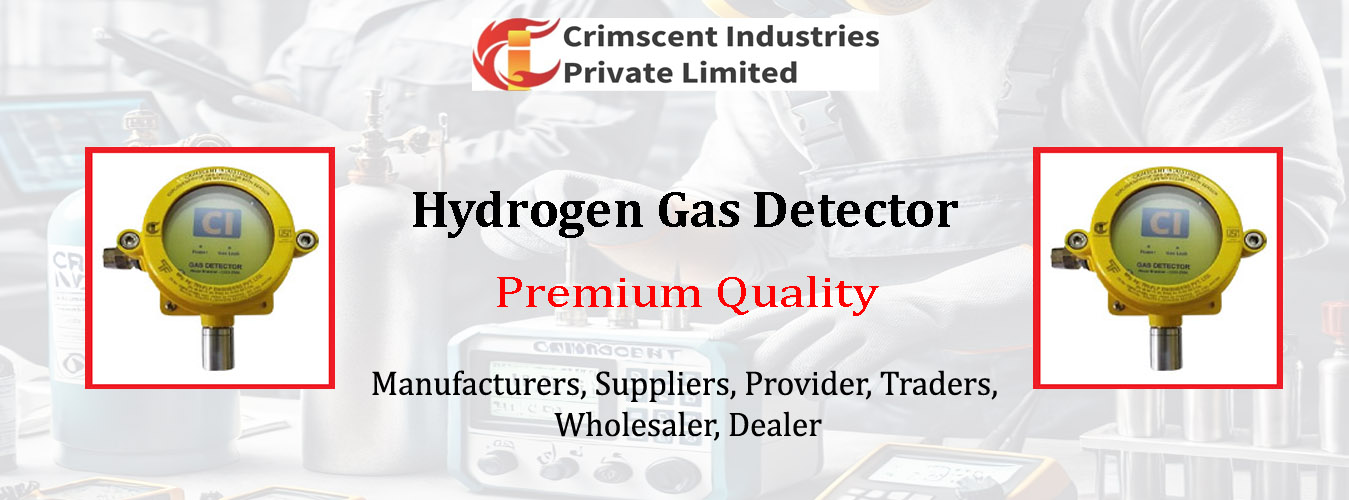
We are leading Hydrogen Gas Detector Manufacturers, Hydrogen Gas Detector Suppliers, Hydrogen Gas Detector Provider, Hydrogen Gas Detector Traders, Hydrogen Gas Detector Wholesaler, Hydrogen Gas Detector Dealer, and Hydrogen Gas Detector Exporter in Mumbai, Navi Mumbai, Thane, and India. Our Hydrogen Gas Detectors ensure fast and accurate detection of hydrogen leaks and hazardous concentrations, offering enhanced safety for industrial, commercial, and laboratory environments.
As dependable Hydrogen Gas Detector Manufacturers and Hydrogen Gas Detector Suppliers, we provide cutting-edge detection solutions engineered for high precision and safety. Our Hydrogen Gas Detector Provider services include professional consultation, customization, and technical assistance. Being trustworthy Hydrogen Gas Detector Traders, Hydrogen Gas Detector Wholesaler, Hydrogen Gas Detector Dealer, and Hydrogen Gas Detector Exporter, we ensure timely supply throughout Mumbai, Navi Mumbai, Thane, and India.
Hydrogen Gas Detector Manufacturers, Hydrogen Gas Detector Suppliers, Hydrogen Gas Detector Provider, Hydrogen Gas Detector Traders, Hydrogen Gas Detector Wholesaler, Hydrogen Gas Detector Dealer, Hydrogen Gas Detector Exporter in Mumbai, Navi Mumbai, Thane, India.
Find answers to common questions about hydrogen gas detectors, hydrogen sensors, hazardous-area detection, installation, and hydrogen storage applications.
A hydrogen gas detector is designed to detect hydrogen (H₂) in the atmosphere. Hydrogen detectors are used in hydrogen production, storage, battery-related applications, laboratories, industrial plants, and other areas where hydrogen leakage may occur.
A detector using a sensor suitable for hydrogen detection is used. Catalytic, electrochemical, semiconductor, and other sensing technologies may be considered depending on the application.
The hydrogen sensor detects H₂ in the surrounding atmosphere and produces a corresponding electrical signal. The detector can then display the concentration or transmit the signal to a control panel or monitoring system.
The sensor technology depends on the required range and application. Catalytic bead and semiconductor technologies are among the technologies used for hydrogen detection, while other technologies may be selected for specific applications.
A flameproof hydrogen gas detector is intended for suitable hazardous areas where hydrogen may be present. The detector must have the appropriate certification and construction for the hazardous-area classification of the installation.
Detector placement depends on hydrogen's physical properties, likely leakage sources, ventilation, and ceiling or roof configuration. Hydrogen is lighter than air, so high-level accumulation should be considered when designing the detection system.
Hydrogen detectors are available in different measurement ranges. For combustible hydrogen monitoring, %LEL ranges such as 0–100% LEL may be used, depending on the detector and application.
It is a hydrogen gas detection product meeting the applicable PESO certification or approval requirements for the relevant application and hazardous-area installation. The specific certificate and scope should always be verified for the product being purchased.
Pricing depends on sensor technology, measurement range, hazardous-area certification, enclosure, outputs, display, and other technical requirements.
A fixed hydrogen detector suitable for the site's hazardous-area classification and environmental conditions can be used. Detector placement should account for hydrogen's tendency to rise and accumulate at high points.
Hydrogen calibration gas is a known concentration of H₂ used to calibrate hydrogen gas detectors and sensors.
Hydrogen calibration mixtures can be specified at different concentrations depending on the detector's range and calibration requirements.
It is a mixture of a specified concentration of hydrogen with air as the balance gas.
Yes, provided the gases are compatible and the resulting mixture is appropriate for the intended detector.
Disposable cylinders can be used for certain calibration gas applications. Cylinder size, pressure, valve and shelf life depend on the gas mixture and cylinder specification.